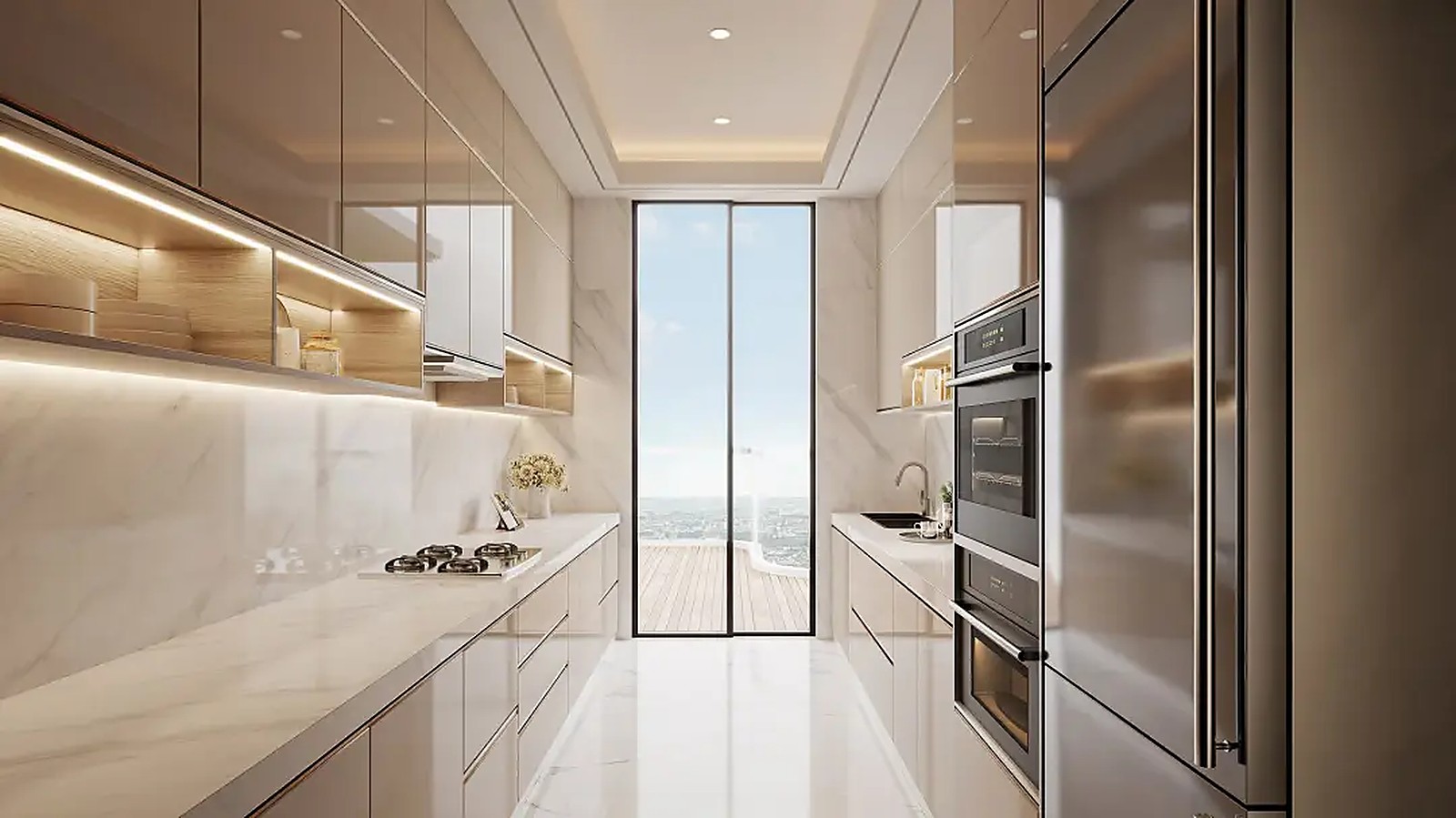

A branded residence is first a home. Understood from a financial perspective, it behaves differently from unbranded luxury: the brand licence, the operating framework and the scarcity of the address each contribute independent components of potential value. This guide walks through the investment logic in detail — how value is generated, where the risks sit, and how to structure diligence for a serious allocation.
- Branded residences typically trade at a 25–40% premium over comparable unbranded luxury; the premium tends to hold or widen on resale.
- Global case studies point to branded schemes outperforming unbranded luxury on capital value metrics over a five-to-seven-year hold.
- Rental yields on branded residences are typically 20–40% higher than comparable unbranded luxury, driven by service depth and short-stay optionality.
- The three value drivers are the address, the operating standard and the licence exclusivity — read together, not in isolation.
- The residential operating agreement is the primary investment document after the title deed; a short licence or a weak service scope compresses long-term value.
The most useful way to think about a branded residence as an investment is to notice that the asset has three distinct components stacked inside a single title deed. The address behaves like any real-estate asset — cyclical, land-driven, corridor-dependent. The physical product behaves like any luxury build — depreciation on the fit-out, scarcity on the plan. The operating framework — the brand licence, the residential operating agreement, the service culture — behaves like a long-dated call option on scarcity and reliability. Value accrues on all three lines, and each moves on its own timeline.
Miss the third component and the analysis collapses into a straight luxury-apartment comparison, which is why most first-time analyses of the category undervalue it. What follows is a working framework for evaluating a branded residence as an investment, grounded in observable evidence from mature markets and adjusted for how the category behaves in India today.
Factors influencing long-term value
Total return on a branded residence, held over a five-to-ten-year horizon, comes from four sources. Sorting them cleanly is the difference between a rigorous investment case and a marketing narrative.
1. Land and corridor performance
The unbranded, address-driven component. In a corridor with expanding infrastructure — a new metro, a new expressway, a new civic anchor — this line does most of the heavy lifting in the first five years. It is the same land-value logic that drives any luxury real-estate return.
2. Product scarcity
How rare the specific residence is inside its building — corner units, top-floor units, particular exposures, larger typologies. Product scarcity typically compounds slower than address appreciation but is more resilient across cycles.
3. Category premium and licence exclusivity
The branded-residence layer. As delivered operating record builds and the market re-prices scarcity, the premium over unbranded luxury tends to widen. Most global brands operate a single-residence-per-city policy for their top marques, which places a structural cap on comparable supply.
4. Operating income (where applicable)
In residences with a formal rental or short-stay programme, the residence produces yield during the hold period. Well-run programmes generate 20–40% higher rents than comparable unbranded luxury, because the operating framework absorbs the service and marketing burden that private landlords otherwise carry themselves.
What the global evidence shows
Two decades of delivered inventory in London, New York, Miami, Dubai and Bangkok produces the reference data. The pattern is consistent across markets and cycles, and worth stating plainly.
The pattern is not driven by the brand nameplate — it is driven by the operating standard the nameplate obliges. When a branded scheme underperforms its unbranded peer, the cause is almost always identifiable in the operating agreement: a short licence, a narrow service scope, an operator with a weak local team. That is why the diligence framework below sits on the operating agreement first and the marketing brochure last.
The India adjustment
India's branded market is early. Reference inventory is thin, delivered operating record is limited, and secondary-market liquidity is still forming. Three adjustments to the global framework matter.
- The category premium is understated in current pricing. Buyers who hold through delivery and the first two-to-three years of steady-state operations effectively acquire the premium at a discount.
- Exit horizons should be longer. Plan for a seven-to-ten-year hold, not a three-to-five. Secondary liquidity builds as the first delivered schemes cross their fifth operating year.
- Corridor selection matters more than brand selection. In a mature market, a wrong-corridor branded scheme is still a good asset. In India today, the corridor decision often dominates the brand decision — get the address right first.
Branded vs unbranded: an investment comparison
| Unbranded luxury | Branded residence | |
|---|---|---|
| Entry premium | Baseline | 25–40% over baseline |
| 5–7 year potential performance | Corridor-driven | Corridor + category premium |
| Rental yield | Address-driven | 20–40% uplift where managed programme exists |
| Operating cost | Owner-managed | Higher service charge, lower owner overhead |
| Resale narrative | Address + finishes | Address + finishes + operating standard |
| Liquidity | Deeper secondary market | Thinner in early markets, deepens with delivered record |
| Downside protection | Corridor cycle only | Corridor cycle offset by brand scarcity and service floor |
Yield, occupancy and the rental programme
Where a residence is bought with rental intent — including partial-year owner occupation — the structure of the rental programme is the single most important operating variable. Three programme types dominate.
Managed long-lease
The operator or a designated leasing partner manages tenant acquisition, rent collection, maintenance and turn-over. Yield is comparable to well-run unbranded luxury plus a service premium; volatility is lower because the operator absorbs vacancy risk into a wider pool.
Managed short-stay / hospitality pool
The residence is offered into a hotel-style booking pool when the owner is not in residence. Yields are typically the highest of the three types but the most cyclical, and the specific revenue share, occupancy cost and owner-use rules should be scrutinised carefully in the operating agreement.
Owner-managed with concierge support
The owner retains full control of the residence but uses the brand's concierge and service network for guests. Yields are unmanaged and vary with the owner's own effort; the appeal is control, not yield optimisation.
The risks — and how to price them
Every asset class has structural risks; branded residences are no exception. Naming them cleanly is what separates a diligence file from a sales pitch.
Licence and operator risk
A short licence, an operator with a weak residential division or an operating agreement with wide termination rights all compress long-term value. Mitigation: read the agreements in full; prefer operators with delivered residential portfolios; check renewal mechanics.
Service-charge inflation
Service charges rise with wage inflation and utility costs. In a well-run residence, charges are set by budget, approved by the association and disclosed transparently. Ask for the historical charge trajectory of comparable schemes by the same operator.
Corridor cycle risk
Even a great residence in a weak corridor underperforms across a full cycle. Mitigation: get the corridor decision right first; branded overlays amplify address decisions, they do not rescue them.
Liquidity risk
Thin secondary markets are the reality in early categories. Plan hold horizons that match the market's maturity; do not underwrite on a three-year exit if the secondary market is not yet formed.
Regulatory risk
Stamp duty and GST rates change; short-stay regulation is being tightened in several Indian cities. Model sensitivity to a 100–200 basis-point movement in total acquisition cost.
Tax and structuring
A branded residence is taxed as residential real estate in India. GST is 5% on under-construction inventory without input tax credit, nil on ready inventory with an occupancy certificate. Stamp duty and registration follow the state schedule. Rental income is taxed under 'income from house property'; a 30% standard deduction applies on annual value, and municipal taxes paid are separately deductible.
For NRIs, FEMA governs source-of-funds and repatriation. Rental income is subject to TDS at 30% for NRI landlords under section 195, refundable against the final tax liability on filing. On sale, long-term capital gains apply after two years of holding, with indexation and section 54/54F reinvestment reliefs available. Where the residence is held in an SPV or family-office vehicle, additional planning around dividend distribution, buyback and gift structuring becomes relevant — advice from a qualified tax counsel is essential.
The diligence framework
- Confirm RERA registration and read the full disclosure — not the marketing summary.
- Read the licence agreement between developer and brand — term, renewal, exclusivity to market.
- Read the residential operating agreement in full, with counsel. This is the primary investment document.
- Model total acquisition cost — headline price, floor and view premiums, stamp duty, GST, one-time charges.
- Model steady-state operating cost — service charge, à la carte scope, sensitivity to wage and utility inflation.
- Understand the rental programme in detail (if applicable) — revenue share, chargebacks, owner-use rules.
- Benchmark against two comparable branded residences and two comparable unbranded luxury addresses in the same city.
- Confirm the developer's approved-project status with the lenders and private banks you intend to use.
- Meet the proposed general manager and residential director where possible.
- Set the exit horizon before you underwrite — not after.
Portfolio positioning
For an individual investor or family office, a branded residence typically sits in the residential sleeve of the portfolio — a hold-to-use, potential hold-to-yield asset rather than a trading position. Sizing depends on total exposure to Indian residential real estate, existing corridor concentration and the intended personal use of the residence. Generally, a branded residence is considered as a long-term hold; anything shorter under-uses the operating layer that makes the asset distinct.
See how the investment logic applies at The Westin Residences, Gurgaon — including corridor context, operating framework and residence typologies.
Frequently Asked
Do branded residences typically outperform unbranded luxury?
Historical global data points to a capital value uplift over a five-to-seven-year hold, plus a rental-yield premium where a managed programme exists. Performance is driven by the operating standard, not just the nameplate — a poorly structured operating agreement can compress the uplift.
What is the typical hold horizon?
Seven to ten years in an early market like India, five to seven in mature markets. Shorter horizons under-use the operating layer and expose the investor to thin secondary liquidity.
How is a branded residence taxed in India?
As residential real estate. GST is 5% on under-construction inventory (nil on ready), stamp duty follows the state schedule, rental income is taxed under 'income from house property' with a 30% standard deduction, and long-term capital gains apply after two years with indexation and reinvestment reliefs available.
Can I rent out a branded residence?
Yes, subject to the operating agreement. Many branded residences offer a managed long-lease or short-stay programme; others allow owner-managed rentals with concierge support. Read the revenue-share, chargeback and owner-use provisions carefully.
What is the biggest investment risk?
A weak operating agreement. A short licence, a narrow service scope or an operator with a thin residential portfolio compresses long-term value more than any other factor. The agreement is the primary investment document after the title deed.
Are branded residences liquid?
Less liquid than unbranded luxury in early markets, comparable or better in mature markets. Plan hold horizons that match the market's maturity; India's secondary market is still forming and will deepen as the first delivered schemes cross year five.
How much of my real-estate portfolio should sit in branded residences?
There is no universal answer. Typically, a branded residence is considered when it can be held through at least one full corridor cycle and when it is not the investor's only Indian residential exposure. Speak to a qualified advisor for allocation-specific guidance.
The Editorial Desk
In-house editorial team
The in-house editorial team at The Westin Residences Gurgaon. We write for buyers, investors and the curious — the way a magazine writes, not the way a brochure does.
View profile